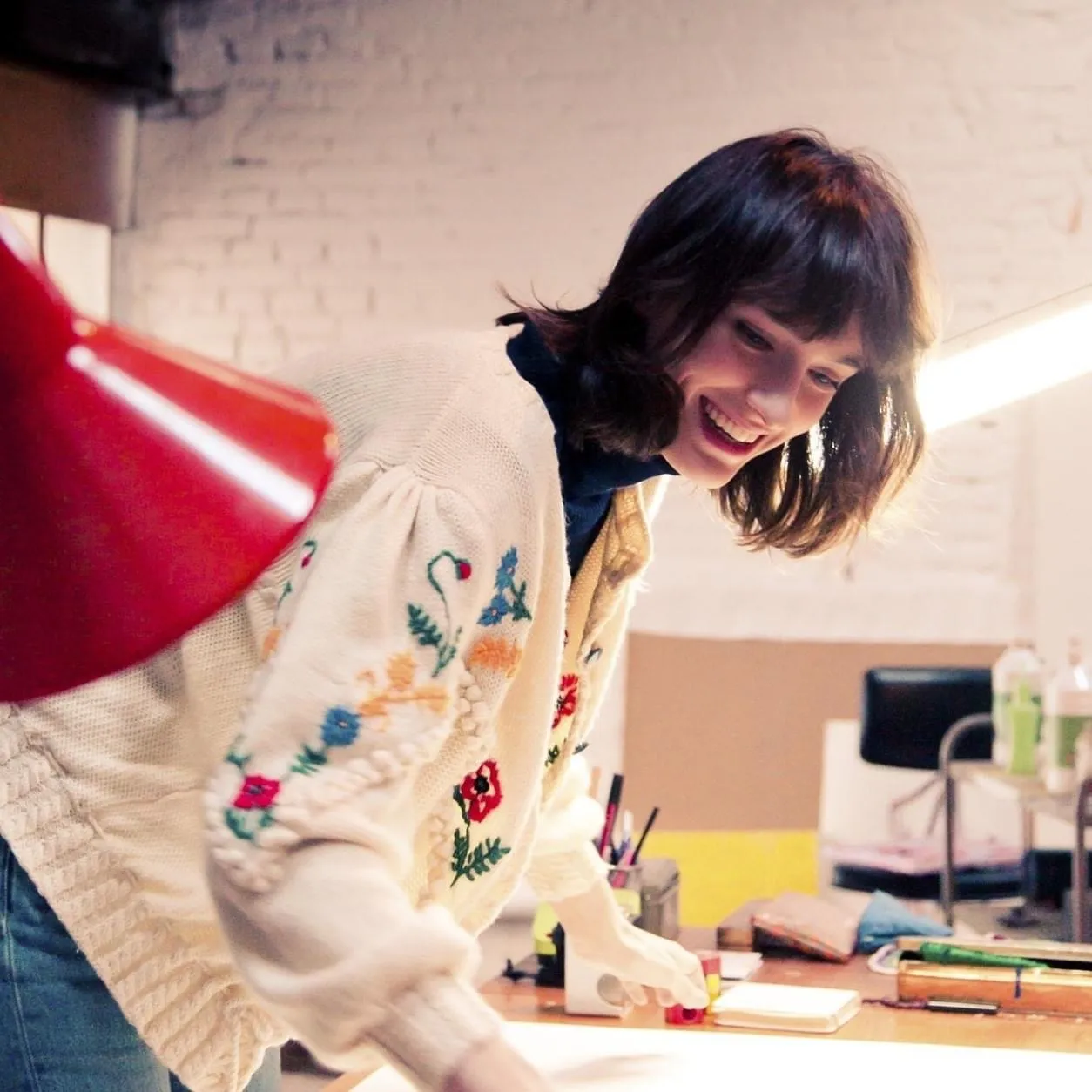
Picture by Olivia Charles
Past Exhibitions
2026 — Group Show · Namur « SEXISME PEPOUZE» · Le Delta
2025 — Group Show · Bxl « SEXISME PEPOUZE» · Galerie That’s What x Said
2024 — Group Show · Bxl « PETITS MONDES » · Galerie Chez Olivia
2024 — Solo Show · Valenciennes « LOOPING » · Galerie Gustave Ansart
2021 — Duo Show · Bxl « O.K. K.O. » · Mise en doute
2021 — Group Show · Bxl « LES SOULIERS ROUGES » · Fondation Moonens
2020 — Group Show · Anvers « WUNDERWALL » · Galerie Sophie Vandevelde
2020 — Solo Show · Bxl « WUNDERWALL » · Galerie +One
2020 — Solo Show · Liège « ART AU CENTRE » · Galerie LPDO
2020 — Solo Show · Bxl « FRUIT LOOPS » · Galerie LA PEAU DE L’OURS
Clémence Didion (Belgium, 1989) build up and moulded a dreamlike introspective atmosphere over the time and through different paths, she developed a world, neither closed nor achieved, wherein everything seems to be frozen, just there on purpose to be admired, ghosts and chimeras are intertwining; cagey minds and spectres are still haunting some thoughts, some pasts. In that realm, paused or slow motioned, beings with no identity are gazing, genderless and with no form of uniqueness. They’re passing by, sluggishly, from one side to the other side of the frame. They’re interchangeable elements. They depict dangling memories. A zany world hinging on roughly painted structures and organic skeletons that are balancing the different arrangements. Despite quietness and order that are ruling there, this environment, similar to its creator, is far from being ‘Edenic’ and idyllic. It’s entropy which coming from the fertile ideas of Clémence that is nourishing her compositions. Motionless cycles, time for our eyes to catch the oversize eyes drawn in coloured hazes. Cartoons alike, they dialogue with interlocking wires and pipes, they kiss rigid tongues and they’re staring at nameless objects. Absurdity seems then to reach its pinnacle.
But… What absurdity are we talking about? How can we understand what is challenging and questioning logic and rationality; our own, in an established world; or hers, obeying formal and structural rules? That’s the key moment we really access the Clémence’s work. Whether two or three-dimensional, pencil or oil, this fictional territory takes us on a journey into her memories, her childhood and her obsessions. Sometimes Japanese alike, sometimes paced with throbbing music or rousing rhythms. In respect of the formal side of her practice, Clémence brings us into a work full of symbols that borrow certain aspects from the Belgian artists Walter Swennen and Leon Spilliaert or the French artist Odilon Redon ; a world that disregards any procedure. A world wherein spontaneity and instinctive language learning are integral part of the artistic process: way more important than the final treatment.
The work gradually evolves organically to open up new formal questions. The main focuses and important questions for Clémence are linked to her own life, her past experiences and the way she could take lessons from her introspective sources. She like to explore the past and share ideas and opinions with artists and people she really does admire. In the manner of the Canadian artist Philippe Guston who spent his life to challenge his own existence and who found way to express his concerns such as the Ku Klux Klan activism, personal distresses, killing the boredom of loneliness or suicidal feelings with a comic strips and naive language. She also mentions quite often the Polish artist Maryan S. Maryan (pseudonym of Pinchas Burstein) as as great inspiration: a post-expressionist painter who explored and pushed the limits of human faces and bodies representation with no limits. Regarding the Armen Eloyan, like a continuous hallucination, the respective subjects chosen follow one another, draw their inspiration from the same places and are shaped over time to finally arrive at a different result. The forms become rounder, more colourful and more animated. In a waking trip that looks like a tale of a contemporary Eugene Ionesco, Clémence is inviting us to leave the childhood and getting closer from a heavier realty; made of trials and mistakes, so as to draw near the vulnerability of a steady existence: as a reverberation, a resonance of our troubles and of our misunderstandings.
Clémence is really affected and concerned by those matters. She reads a lot of psychology and psychoanalysis. She’s fascinated by the She, evokes Carl Gustav Jung, a Swiss psychoanalyst, she talks about with importance. It’s important to face the facts: Jung was a great admirer of the Odilon Redon’s work and Federico Fellini, one of her favourite filmmaker, was himself highly influenced by Jung’s dreams analysis essays and theories. She then developed ‘natural’ bonds with writers and artists who play with the images and the vocabulary of the subconscious. Jung liked to describe his practice as an “active imaginary”, in other words a practice allowing a genuine self discovery inextricably linked to a full perception of life. She really like to let images filling our minds instead of forcing them. She said that
I would like to have a stronger command of that language. To understand better how to make those instantaneous shapes to appear
It would be a perfect way for her to gain strength and conviction in her drawing and painting act.
— By Vince Vanden Bogaard in « HART Magazine », 2021
Cursus
BACHELIER & MASTER EN PEINTURE - La Cambre
BACHELIER EN ILLUSTRATION - Saint Luc Liège